How to Give Every Family Member Personal Storage in Small HDB Flat Without Creating Clutter
Personal Storage in a Small HDB Flat. Indeed. There is a high probability that a small three-room HDB flat will become cramped if six individuals insist on having their own cupboards or cabinets, as everyone anticipates full-sized furniture.
The issue is not ownership. The issue is the amount of physical volume each person occupies.
People often say:
“I want my own cupboard.”
That is a reasonable desire.
What is usually unreasonable in a small flat is:
“I want my own full-sized wardrobe, cabinet, drawer unit, bookshelf, and storage space.”
“I want my own personal storage in small HDB flat”
Those are two different things.
The solution is to preserve personal ownership while changing how storage is allocated.
1. Separate Ownership From Furniture
Instead of:
❌ Six wardrobes.
Use:
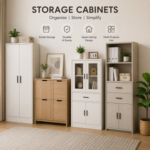
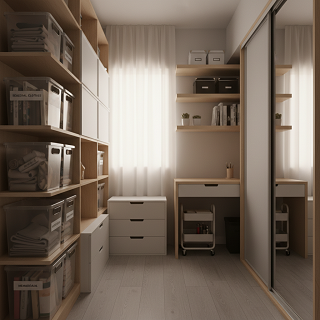
✅ One large built-in cabinet divided into six clearly labeled sections.
Each person gets:
- Their own shelves.
- Their own drawers.
- Their own hanging space.
- Their own lockable compartment if necessary.
Psychologically:
- Ownership is preserved.
- Privacy is maintained.
- Space consumption is drastically reduced.
The cabinet belongs to everyone, but the spaces inside belong to individuals.
2. Establish Equal Space Quotas
A difficult but necessary conversation:
If six people live in a small home, then everyone must accept similar limits.
For example:
Each person receives:
- One clothing section.
- One personal storage box.
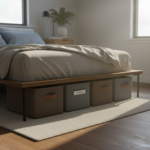
- One under-bed drawer.
- One small cabinet or locker.
No exceptions unless there are special needs.
Without boundaries, one person’s possessions expand until everyone else loses space.
3. Use Vertical Lockers Instead of Wide Cabinets
Think like a gym, hostel, or military barracks.
Instead of:
❌ Six 90-cm wardrobes.
Use:
✅ Six tall, narrow lockers.
Benefits:
- Personal ownership remains intact.
- Lockable privacy.
- Far smaller footprint.
- Easier organization.
Six narrow units against one wall consume much less space than six traditional wardrobes.
Tall Narrow Storage
4. Introduce the “One In, One Out” Rule
In cramped homes:
Buying something new means removing something old.
Examples:
- New shoes → donate old shoes.
- New clothes → remove unused clothes.
- New electronics → discard broken ones.
Otherwise, personal storage expands indefinitely.
5. Recognize Emotional Reasons
Often, people do not insist on separate cupboards because of storage needs.
They want:
- Independence.
- Privacy.
- Security.
- Control over their possessions.
- Protection from siblings borrowing items.
The conflict is rarely about furniture.
It is about trust and personal boundaries.
Solutions include:
- Lockable drawers.
- Individual labels.
- Family agreements.
- Respecting ownership.
You can preserve dignity without requiring enormous furniture.
Drawers/Lockers with Individual Lock
6. The Mathematics Cannot Be Ignored
Let’s be brutally practical.
Suppose:
- Each wardrobe is 1 meter wide.
- Six people require one each.
That is 6 meters of wall space.
A typical HDB bedroom may only have:
- 3–4 meters of usable wall length.
The numbers simply do not work.
No amount of negotiation changes geometry.
The choice becomes:
Option A
- Everyone gets large personal furniture.
- Rooms become crowded.
- Poor airflow.
- Difficult movement.
- Higher stress.
Option B
- Everyone gets smaller, clearly defined personal spaces.
- Shared infrastructure.
- Better quality of life.
The second option is usually the more sustainable compromise.
Modular Narrow Wardrobes – Suggested
7. A Better Compromise
Instead of saying:
“We share everything.”
Try:
“We share the furniture, but not the contents.”
Examples:
| Shared Structure | Personal Ownership |
|---|---|
| Built-in wardrobe | Individual shelves |
| Shoe cabinet | Assigned compartments |
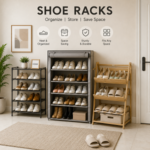
| Storage rack | Numbered bins |
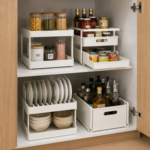
| Kitchen pantry | Separate labeled baskets |
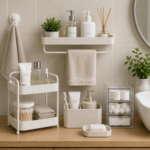
| Bathroom cabinet | Personal containers |
This preserves identity while respecting physical limitations.
The Hard Reality
If six people in a small HDB flat all require full-sized, independent storage systems, the home will become overcrowded. That is not a matter of opinion; it is basic spatial economics.
The practical resolution is:
- Shared storage structures.
- Individual compartments.
- Clearly defined ownership.
- Strict limits on volume per person.
- Regular decluttering.
The goal is not to force people to share possessions. The goal is to share space efficiently while preserving personal autonomy.