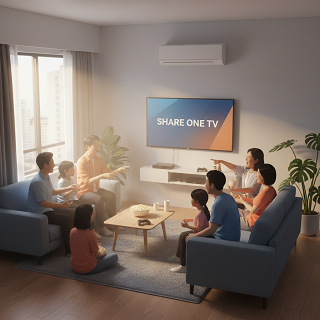
How Families Can Share One TV in a Small HDB Flat Without Arguments
No, in a small HDB flat, having six separate televisions for six people is generally impractical. The problem is not merely electricity or cost—it’s space, noise, attention, and family dynamics.
That said, the desire itself is understandable. Each person has different interests, schedules, and entertainment preferences.
The challenge is to satisfy individual choice without multiplying physical devices.
Option 1: One Main Television, Personal Devices
This is the most realistic modern solution.
- One family television in the living room.
- Individuals use phones, tablets, laptops, or headphones for personal viewing.
- The TV becomes a shared resource rather than a personal possession.
Small Portable TVs for Personal Viewing
Today, many people already consume content through streaming services rather than fixed channels.
The television handles:
- Family movies.
- Major sporting events.
- Shared news programs.
- Weekend entertainment.
Everything else can move to personal devices.
Option 2: Establish Viewing Schedules
If the household strongly prefers traditional television:
| Time | Priority |
|---|---|
| 6:00–7:00 PM | News |
| 7:00–8:00 PM | Children |
| 8:00–9:00 PM | Parents |
| 9:00–10:00 PM | Teenagers |
Not everyone will get exactly what they want all the time, but fairness matters more than perfection.
Shared living always requires negotiated access to common resources.
Option 3: Headphones Are Essential
One of the greatest sources of tension in crowded homes is noise.
Wireless headphones can solve many problems:
- One person watches dramas on a tablet.
- Another follows sports on a phone.
- Someone else listens to music.
- The main television remains available for shared use.
Physical space is limited, but audio space can be individualized.
Headphones – Home Usage
Option 4: Recognize That Television Has Changed
The old model was:
One TV, everyone watches the same channel.
Then came:
One TV per bedroom.
Now, for many households, the reality is:
One large communal screen plus personal digital devices.
A smartphone is effectively a personal television that fits into a pocket.
Trying to replicate older living patterns inside a compact modern flat often creates unnecessary conflict.
Small Portable TVs for Personal Viewing
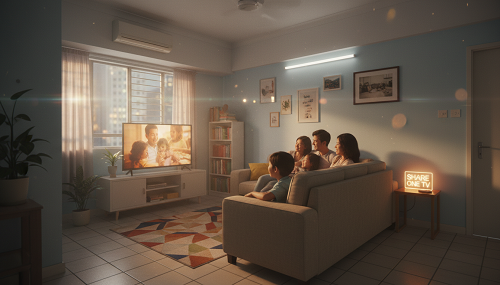
The Deeper Issue: Fairness Versus Freedom
The real question is not:
“Can we have six televisions?”
The question is:
“How much individual freedom can exist within a shared environment?”
The undeniable truth is this:
Living with six people means some resources must remain communal:
- Kitchen.
- Bathrooms.
- Dining areas.
- Washing machines.
- Refrigerators.
- Televisions.
If every person demands complete independence in every aspect of daily life, the household begins to resemble six separate apartments occupying one flat—which is physically impossible.
A Practical Compromise
A balanced arrangement might be:
- One large smart TV in the living room.
- One or two family tablets shared when needed.
- Personal smartphones for individual viewing.
- Headphones as standard equipment.
- Agreed family hours for communal programs.
This preserves:
- Personal preferences.
- Space efficiency.
- Household harmony.
- Lower electricity and equipment costs.
The principle is the same as with cupboards and furniture:
People do not necessarily need their own physical infrastructure. They need ownership, choice, and respect within shared infrastructure.
That distinction is what makes dense urban living workable.
Small Portable TVs for Personal Viewing
Small portable TVs are a practical solution for families living in compact HDB flats where everyone has different entertainment preferences. Instead of crowding around a single television or buying multiple full-sized TVs, a portable TV allows one person to enjoy their favorite programs without occupying much space.
Modern portable TVs are lightweight, easy to move between rooms, and can be placed on a bedside table, study desk, or kitchen counter. Many models also include rechargeable batteries, digital TV reception, HDMI inputs, and USB media playback, making them suitable for both home and travel.
For large households, portable TVs offer greater flexibility while helping to reduce conflicts over shared entertainment. They provide a personal viewing experience without permanently taking up valuable floor space, making them a practical addition to small HDB homes in Singapore.