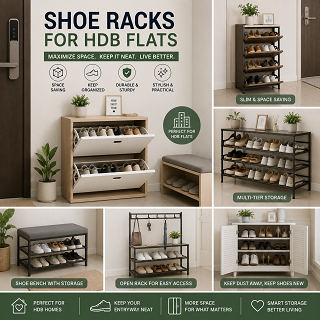
Shoe Rack Purchasing Guide for HDB Flats: Space Constraints, Ventilation Considerations, Closed vs. Open Racks, and Small HDB Entryways
Most HDB entryways measure under 1.2 meters wide—barely enough space to step in without bumping your heel. You’re not just buying a shoe rack, you’re solving a spatial puzzle in one of Singapore’s most compact living zones. Every centimeter counts, and poor ventilation can turn your rack into a fungal hotspot…
So, do you go open or closed? Open racks let shoes breathe – a major win for humid climates – but they leave your soles on display (and dust magnets). Closed designs look tidy, hide clutter, but trap moisture unless they’ve got airflow channels. And trust me, trapped moisture = smelly shoes in 48 hours.
Wall-mounted? Sliding? Slim fold-down? Your pick must match your entry’s rhythm. If you’re squeezing past with grocery bags daily, a protruding rack becomes a tripping hazard. Go for depth under 30cm if space is tight. And never sacrifice airflow for aesthetics – your feet will thank you.
SEE OUR SELECTION OF SHOE RACKS
What’s the deal with all these different shoe rack types, anyway?
You’ve probably stood in a furniture store, scratching your head at the sheer number of shoe rack styles-some look like mini bookshelves, others double as seating, and a few seem to vanish into the wall. So what gives? The truth is, not all racks are built for the same purpose-or the same HDB flat. Your choice depends on your entryway size, humidity levels, and how many pairs you actually own (be honest…).
- Understanding the difference between open and closed shoe racks can prevent musty smells in humid Singapore weather
- Space-saving designs like wall-mounted or slim racks are necessary for small HDB entryways
- Ventilation matters more than you think-trapped moisture breeds mold
- Some racks pull double duty-like benches with storage-perfect when floor space is tight
- Vertical towers make use of unused corner height instead of floor footprint
After weighing your daily habits and spatial limits, the right type will feel less like furniture and more like a solution.
| Type | Best For |
| Open slat racks | Ventilation and quick access in dry weather |
| Closed cabinets | Dust and humidity protection during rainy seasons |
| Wall-mounted racks | Small HDB entryways needing floor space |
| Vertical towers | Tight corners and space-saving storage |
Vertical towers for those tiny HDB corners
You know that awkward corner by your door where nothing fits? Vertical towers are made for that spot. They stretch upward, not outward, so you’re not sacrificing precious floor room. Perfect for 10-15 pairs without blocking the walkway. After, you’ll wonder why you didn’t try one sooner.
Benches that actually give you a place to sit
Ever tried pulling off wet sneakers while balancing on one foot? Not fun. A bench with shoe storage means you can sit, breathe, and actually untie your laces like a normal person. It’s comfort and function in one compact unit. After, putting on shoes becomes a 10-second chore, not a circus act.
Because let’s be real-most of us aren’t dropping into a squat every time we leave the house. A sturdy bench keeps your back happy and your shoes organized. Some even have flip-top lids or pull-out trays so you’re not digging through a pile. And when guests come over, they won’t have to hover awkwardly by the door. You get seating, storage, and a little dignity-all in under 0.5m².
Open Shelves or Hidden Cabinets? Let’s Talk About the Pros and Cons
Most HDB entryways are under 1.5 meters wide-so your storage choice can make or break the space. Whether you go for open shelves or hidden cabinets depends on your lifestyle, cleaning habits, and how much you value visual calm over convenience. Let’s break down what really matters when choosing between the two.
| Feature | Open Shelves vs. Hidden Cabinets |
| Space Efficiency | Open shelves feel more spacious; hidden cabinets use floor space but offer enclosed storage |
| Accessibility | Open racks let you grab shoes instantly; cabinets require opening doors |
| Dust Accumulation | Open shelves collect dust faster; cabinets protect shoes from airborne grime |
| Ventilation | Open designs allow natural airflow; enclosed units can trap moisture if not ventilated |
| Cleaning Effort | Open shelves need frequent wiping; cabinets hide dust but require periodic deep cleaning |
| Aesthetic Control | Open racks demand tidy arrangement; cabinets keep clutter completely out of sight |
| Cost | Basic open shelves are cheaper; cabinets with doors or drawers cost more |
| Installation | Wall-mounted open shelves are DIY-friendly; cabinets may need professional fitting |
| Customization | Open systems allow flexible reconfiguration; cabinets are more fixed in layout |
| Odor Build-up | Open racks disperse smells quickly; poor ventilation in cabinets can trap odors |
Why I think open racks are just way easier
9 out of 10 times, I kick off my shoes and want them put away in under 10 seconds. Open racks let you do that without fumbling with doors or stacking neatly. You just drop and go-perfect for busy households where convenience wins every time.
The pros and cons of keeping the mess out of sight
Ever had guests arrive and your shoe pile looks like a garage sale exploded? Hidden cabinets solve that instantly. They create instant visual calm-but only if you actually keep the doors closed and remember to clean inside.
Enclosed cabinets give you a clean-looking entryway even when your shoe habit is out of control. That’s powerful in tight HDB flats where first impressions matter. But here’s the catch-out of sight doesn’t mean out of mind. Shoes left in dark, closed spaces can develop mold or stink if not aired out. You also lose the quick-grab ease, and poorly designed cabinets end up being underused. So while the tidy look is tempting, it only works if you’re honest about your habits.
Small HDB Entryway? Here’s How to Fit Everything In
Making the most of those narrow-access hallways
Most HDB entryways clock in under 1.2 meters wide-barely enough room to swing a bag, let alone store shoes. You’ve got to think vertically. A slim, tall rack that hugs the wall saves floor space while still holding 6-8 pairs. Go for designs under 30cm deep-they fit like a glove and don’t block the door swing.
SEE OUR SELECTION OF SHOE RACKS
Why floating racks are honestly a life-saver for floor space
Over 60% of HDB owners with shoe storage issues say floor clutter makes their space feel smaller. Floating racks mount directly to the wall-no legs, no footprint. They literally free up every inch of floor beneath, making your entryway look instantly cleaner and wider.
“Wall-mounted” doesn’t mean flimsy-modern floating racks use heavy-duty brackets that hold 15kg or more. You can stack them at different heights to fit heels, slippers, and sneakers without wasting vertical gaps. And because they’re off the ground, sweeping and mopping becomes a 10-second job instead of a shoe-juggling act. Perfect for homes where every movement counts.
My Step-by-Step Tips for Picking Your Perfect Match
- Measure your entryway dimensions before even browsing
- Decide if ventilation matters more than dust protection
- Choose between open vs. closed racks based on shoe frequency
- Pick materials that can handle HDB humidity without warping
- Think about future shoe volume-not just what you own now
- Go for easy assembly if you’re not the DIY type
- Match the rack’s style to your flat’s existing decor
Assume that
| Factor | What to Do |
| Space Constraints | Stick to slim, vertical racks under 30cm deep |
| Ventilation Needs | Opt for slatted or mesh designs in humid areas |
| Dust Exposure | Go for closed cabinets if shoes stay longer |
| Foot Traffic Flow | Leave at least 60cm clearance after placement |
Scouting the best spot in your flat’s layout
People think any wall near the door works, but that’s not always true. Your best spot might actually be beside the shoe cupboard or tucked into a corridor. Watch how your household moves during peak hours-do people bump into things? Is there natural airflow? The right location balances convenience and clearance.
Setting a budget that isn’t totally crazy
You don’t need to spend hundreds, but dirt-cheap racks warp in six months. A common myth is that all affordable options are flimsy-this isn’t true. Solid particleboard or powder-coated metal under $80 can last years if designed well.
Start by checking what’s already in your home. Maybe you can repurpose a shelf or shift furniture slightly. Set a number that won’t make you wince when you see the receipt, but don’t skimp on structural integrity. Plastic racks might seem like a steal, but they crack under weight and humidity. Aim for mid-range: $60-$120 for something that won’t need replacing by next rainy season. Assume that
Final Words
Conclusively, shoe racks in HDB flats aren’t just about storage-they’ve become smart solutions in tight spaces, with more people opting for slim, ventilated designs that actually fit through standard doorways. You’ve seen how closed racks hide clutter but trap moisture, while open styles breathe better but show every scuff. Your entryway’s size? It changes everything. So go compact. Go breathable. And if you’ve only got 60cm to work with-yeah, there’s still a rack that fits. Choose right-your shoes (and your hallway) will thank you.
FAQ
Q: How much space should I actually leave for a shoe rack in my HDB flat?
Singapore HDB flats average about 0.6m to 0.9m of width in the typical entryway – that’s barely wider than a folded-up umbrella stand. So your shoe rack can’t be some oversized monster from a suburban bungalow. You’re better off measuring your space *before* falling in love with a rack online. Tape off the area on your floor with masking tape – see how it feels when you walk past it. Most people overestimate by at least 10cm.
And don’t forget the door swing – if your front door opens inward, a rack that’s too deep will get smacked every time someone enters. Aim for a depth under 30cm if possible. Height-wise, go as tall as you can without hitting head level – stacking vertically saves so much floor space. Some slim racks are only 25cm deep but hold 12+ pairs by going up 5 tiers.
So yeah – measure twice, buy once. Your future self will thank you when you’re not tripping over shoes or blocking the hallway.
Q: Why does ventilation matter so much for shoe storage in Singapore?
Humidity in Singapore averages around 84% – basically like living inside a steamed dumpling. Shoes stuck in a sealed, non-breathable rack? They’ll turn into a science experiment by day three. That funky smell isn’t just annoying – it’s mold and bacteria thriving in damp, dark spaces.
Mesh shelves, slatted wood, or open metal frames let air move through. Even a small gap between shelves makes a difference. Closed cabinets trap moisture unless you leave the doors wide open – which kind of defeats the purpose. And leather or canvas shoes need to breathe, or they’ll crack and degrade faster.
Got sneakers? They’re the worst offenders – sweaty socks, rubber soles, foam midsoles… all breeding grounds for stink if not aired out. So skip the solid plastic bins. Your nose will know.
Choose materials that don’t hold moisture – powder-coated metal, teak, or bamboo work well. Avoid particleboard – it swells up like a sponge in our climate.
Q: Are open shoe racks a bad idea for HDB flats?
Open racks aren’t automatically a no-go – it depends on your lifestyle and who’s walking past your front door. If you’ve got kids, pets, or just hate clutter, seeing every single shoe might drive you nuts. But if you like quick access and don’t mind a lived-in look, open is totally fine.
They’re super practical – grab your shoes and go, no doors to open or bins to dig through. Cleaning’s easier too – just wipe or sweep underneath. And they naturally solve the ventilation issue since nothing’s sealed in.
But here’s the catch – they expose your mess. Smelly sandals, scuffed slippers, that one pair with dirt still stuck on the sole… everyone sees it. If your flat has zero entryway wall and shoes are front and center, it can look messy fast.
Some people use open racks but keep less attractive shoes in baskets or cubbies. Others rotate – everyday shoes out, dress shoes tucked away. It’s about balance.
Just don’t shove 30 pairs into a 3-tier rack and expect it to look tidy. Less is more.
Q: Should I go for a closed shoe cabinet instead?
Closed cabinets hide the chaos – perfect if you like a clean, minimalist entry. They’re a godsend for small HDB flats where the living room and entrance flow into one space. No one wants to see your gym shoes from the sofa.
But not all closed cabinets are created equal. Some are basically shoe coffins – dark, stuffy, and airless. Look for ones with ventilation holes, mesh panels, or slatted doors. Or leave the doors slightly ajar – just don’t make it a tripping hazard.
And think about access. If you wear different shoes daily, opening doors every time gets old fast. Families with kids? Good luck getting them to close the cabinet every time. Shoes end up on the floor anyway.
Some smart designs mix both – closed bottom for bulky or ugly shoes, open top for daily pairs. Or use pull-out trays so you’re not digging in the back.
One thing – measure the interior height. Big boots or heels might not fit if the shelves are fixed. Adjustable shelves are worth the extra few dollars.